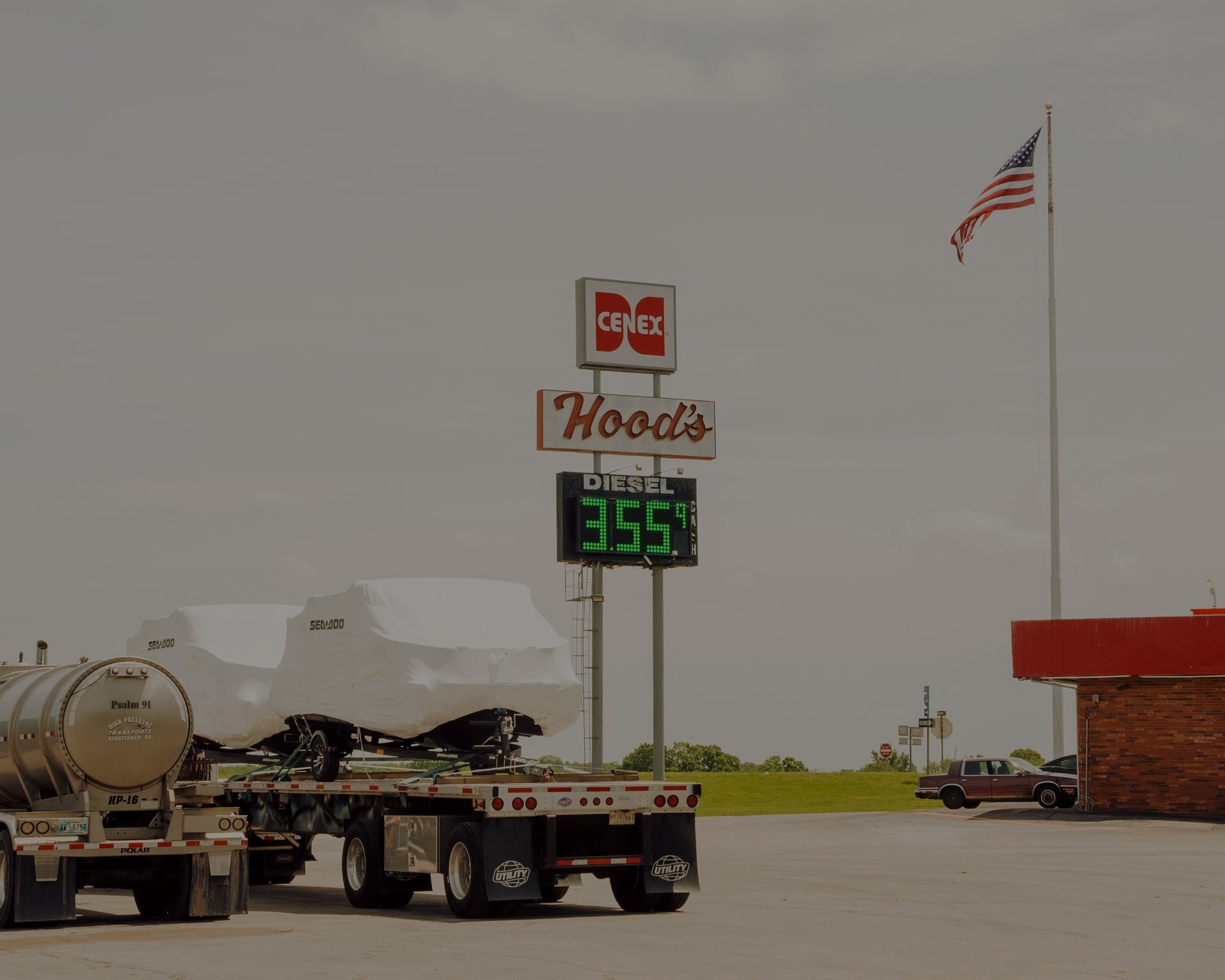
There's a version of fuel strategy that costs more than it saves: running 22 miles off-route because an app showed diesel eleven cents cheaper, then sitting eight deep in the fuel lane.
On a 100-gallon fill, eleven cents saves you $11. The detour adds 44 miles round trip — about 6.8 gallons at 6.5 mpg, or $27 of fuel — plus most of an hour you could have been loaded. That's the whole problem with fuel strategy in one stop: the price on the sign is the least important number involved.
Fuel is the biggest variable cost on your truck — roughly a third of what it takes to turn the wheels. Here's what actually moves it.
The only number that matters is per mile
Price per gallon is a distraction. Your break-even worksheet needs fuel expressed the same way everything else is:
fuel cost per mile = price per gallon ÷ miles per gallon
At $4.00 and 6.5 mpg, that's $0.615 a mile. Now change one variable at a time and watch which one is worth chasing:
| Change | New cost/mile | Saved over 100,000 miles |
|---|---|---|
| Diesel drops $0.10/gal (6.5 mpg) | $0.600 | $1,538 |
| You gain 0.5 mpg (7.0 mpg, $4.00) | $0.571 | $4,396 |
| Both | $0.557 | $5,824 |
Half a mile per gallon beats a dime at the pump, roughly three to one — and unlike the dime, it applies at every stop, in every state, for the life of the truck. Most drivers spend their attention on the number they don't control.
The low-tax state isn't saving you the tax
This one costs people real money because it feels smart. You cross into a state with cheap diesel, top off, and figure you just beat the tax man.
You didn't. Under IFTA, fuel tax is owed on the miles you drive in each state, not the gallons you buy there. Buy 150 gallons in a low-tax state and run those miles in a high-tax state, and your quarterly filing settles the difference — you write a check for exactly what you avoided at the pump. The tax portion of the price is a wash by design.
What isn't a wash:
- The pre-tax price itself, which genuinely varies by market and by how far the terminal is.
- Your network discount, which can be 20–60 cents a gallon off retail depending on the chain and your volume.
- The cash-vs-credit spread on the sign, which usually isn't the price you'd pay anyway.
So compare your price after discount at each stop — not the number on the sign, and not the state's reputation.
Buy fuel to reach fuel, not to fill the tank
Two habits worth building:
- Progressive fueling. If you're at an expensive stop and a cheap one sits 190 miles ahead, buy enough to get there comfortably plus reserve — not a full 200 gallons at the bad price. The savings are small per stop and constant over a year.
- Watch the weight. Diesel runs about 7 pounds a gallon. A full 250-gallon setup is roughly 1,750 pounds of payload you can't carry. On heavy loads, running lighter on fuel is the difference between legal and a scale ticket.
The four levers that actually move mpg
Speed. The single biggest one. Above about 60 mph, every extra mile per hour costs you roughly a tenth of a mile per gallon. Running 68 instead of 62 costs you around 0.6 mpg — better than six cents a mile — to arrive about half an hour earlier on a 400-mile day. You don't get paid for arriving early. You get paid for the load.
Idling. A truck idles about 0.8 gallons an hour. Eight hours a night, four nights a week, forty weeks a year is 1,024 gallons — over $4,000 a year to keep the cab comfortable. That's the math that makes an APU or a bunk heater pay for itself in a couple of seasons, and it's why a $30 parking spot with shore power is sometimes the cheapest thing at the exit.
Tire pressure. Ten psi under across a set costs roughly 1% in fuel economy, and low tires die early on top of it. A five-minute gauge check at every fill is the highest-return maintenance habit there is.
Aero and alignment. Trailer gap, skirts, and a truck that isn't dog-tracking are worth a few percent between them. You won't feel any of it — you'll only see it in the log.
Track mpg per tank, not per month
Write down odometer and gallons at every fill. Two numbers, ten seconds. Then divide.
Per-tank mpg is worth more than the fuel savings, because it's the earliest warning system your truck has. A quarter-mpg drop that doesn't come back is a dragging brake, a plugged filter, a sticking injector, or a tire going soft — found weeks before it becomes a breakdown at the worst possible exit. A monthly average smears all of that into noise.
What a year of this is worth
| Lever | Per year (100,000 mi) |
|---|---|
| Slow from 68 to 62 mph | ~$6,300 |
| Cut overnight idling in half | ~$2,000 |
| Keep tires at spec | ~$600 |
| Chase 10¢/gal on the sign | ~$1,500 |
Notice that the one everybody spends their attention on is last. None of these require a new truck, a new lane, or a better rate — three of the four cost nothing but attention.
And that's the point worth holding onto: your rate is negotiated once per load, but your fuel cost per mile is negotiated every hour you're behind the wheel. Fix the number that's always running.
We're building this into Haitruck — your real cost per mile, fuel included, run against every load card before you book it. Join the waitlist at haitruck.us/join-waitlist to get it first.